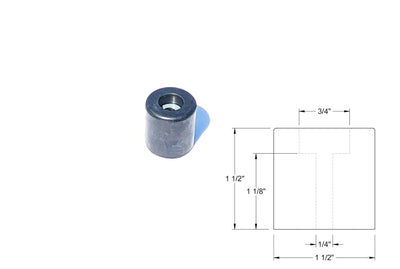
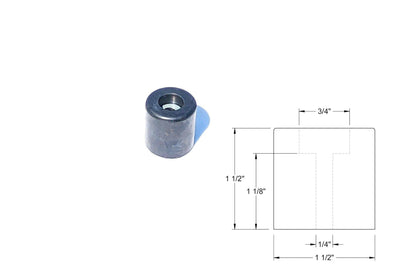
Quick answer: for speakers and subwoofers, a screw-on rubber foot 1-1/2" in diameter and 1-1/2" tall is a popular size. It lifts the cabinet off the floor, keeps it from sliding, and puts a layer of rubber between the cabinet and the floor. Our foot has a 3/4" recess with a built-in metal washer and a 1/4" screw hole, and takes a #12 wood screw. Buy single feet, a subwoofer 4-pack with or without screws, or case packs for speaker builds.
Why put rubber feet on a speaker or subwoofer?
- Decoupling from the floor: rubber between the cabinet and the floor reduces how much cabinet vibration passes into the floor and the room. That matters most with subwoofers on wooden floors.
- Clearance: down-firing subwoofers and bottom ports need a gap under the cabinet. A 1-1/2" foot gives a fixed, even gap.
- Grip and floor protection: rubber stops cabinets walking across the floor and won't scratch hardwood, tile or laminate the way bare cabinets or metal spikes can.
- Level and stable: four identical feet give a stable stance, even on carpet.
Rubber feet vs spikes vs pads
| Option | Best for | Watch out for |
|---|---|---|
| Screw-on rubber feet | Subwoofers, floor-standing speakers, PA and bass cabinets on hard floors or carpet | Need screw holes in the cabinet base |
| Metal spikes | Coupling a speaker firmly to the floor through carpet | Can scratch or dent hard floors without cups |
| Stick-on pads | Bookshelf speakers and small monitors | Adhesive can let go under a heavy cabinet; little clearance |
For a comparison of mounting styles, see screw-on vs push-in vs self-adhesive rubber feet.
Specifications: 1-1/2" x 1-1/2" speaker and subwoofer foot
| Specification | Value |
|---|---|
| Diameter | 1-1/2" |
| Height | 1-1/2" |
| Recess opening | 3/4", with a built-in metal washer |
| Screw hole | 1/4" |
| Recommended screw | #12 x 2-1/2" (included with the "+ Screws" option) |
| Material | Solid SBR rubber, 60±5 durometer, black, non-marking |
| Sold as | single foot, 4-pack, single with screw, or bulk case |
Specifications are from our product listings. Other sizes are in the rubber feet size chart.
How to fit rubber feet to a speaker cabinet
- Lay the cabinet on its side or top on a blanket. Remove any old feet or glides.
- Mark four positions about 1" in from each corner, clear of any port, driver or internal bracing.
- Check the screw length before drilling. The screw passes through the foot's washer into the cabinet base, so it must not go through the bottom panel into the cabinet or touch a driver. Choose a shorter screw if the base panel is thin.
- Drill a pilot hole at each mark, then drive the screw through the foot until the foot is held firmly. Don't overtighten.
- Stand the cabinet up and check that it sits level on all four feet.
Buying in bulk? Case pricing.
Need hundreds or thousands of speaker and subwoofer feet for a production run, a fleet or a resale shelf? Our most-stocked sizes come in case packs at a lower price per piece than single pieces, and we quote larger quantities on request.
Speaker builders, installers and music stores use this foot on cabinets, amps and subwoofer boxes. Case packs are priced well below single feet. See bulk case pricing.
Other uses for the same foot
The same 1-1/2" x 1-1/2" foot is used under treadmills and exercise equipment, guitar amps and pedalboards, turntable stands, PC cases, furniture and workshop equipment. See also our guide to rubber feet for guitar pedals and pedalboards.
Frequently asked questions
What size rubber feet do I need for a subwoofer?
Pick a foot tall enough to give any down-firing driver or bottom port the clearance its maker recommends. A 1-1/2" tall foot suits many subwoofers. A wider foot spreads the contact over more floor. Check the space you have on the cabinet base for a 1-1/2" diameter foot.
Should I use rubber feet or spikes under a subwoofer?
On hard floors, rubber feet grip without scratching and reduce the vibration passed into the floor. Spikes are mainly used to couple a speaker firmly through carpet. Many owners try both and keep what sounds best in their room.
What screws do I use?
The listing recommends #12 x 2-1/2" screws, which are included with the "+ Screws" option. Check that the screw won't pass through the base panel into the cabinet, and use a shorter screw if needed.
How many feet does a speaker need?
Four, one near each corner, is standard for subwoofers and floor-standing speakers. Very long cabinets sometimes use a fifth or sixth in the middle.
Can I buy speaker feet in bulk?
Yes. Single feet, 4-packs and case packs are available. See bulk case pricing.