Quick answer: a washer is a flat ring that sits under a bolt head, screw or nut. A rubber washer cushions, spaces and seals around the fastener. A gasket is a flat seal shaped to fit between two mating surfaces, such as a flange, lid or cover. An O-ring is a round-section ring that seals when it is squeezed, usually in a groove. If your seal sits under a fastener, you want a washer. If it fills a flat joint between two parts, you want a gasket. If the part has a groove for it, you want an O-ring.
Gasket vs washer vs O-ring at a glance
| Rubber washer | Gasket | O-ring | |
|---|---|---|---|
| Shape | Flat ring with a centre hole | Flat sheet cut to the shape of the joint | Round ring with a circular cross-section |
| Where it sits | Under a bolt head, screw head or nut | Between two flat mating faces | In a groove, or around a shaft or fitting |
| How it seals | Clamped flat by the fastener | Clamped flat across the whole joint | Squeezed out of round, so it presses against both surfaces |
| Typical jobs | Sealing a screw through a panel, cushioning, spacing, stopping rattles | Flanges, covers, lids, pump and housing faces | Filter housings, faucet stems, pump and hydraulic fittings, caps |
| What to measure | Outside diameter, inside diameter, thickness | The joint outline and bolt holes, plus thickness | Inside diameter and cross-section |
What a rubber washer does
A metal washer spreads a fastener's clamping force and protects the surface. A rubber washer does that job too, but the rubber also compresses, so it fills small gaps around the bolt and under the head. That makes it the usual choice for:
- sealing a screw or bolt that passes through sheet metal, a panel or an enclosure
- cushioning and isolating two hard parts so they don't rub, rattle or transmit vibration
- spacing a part off a surface; thicker washers are often sold as spacers or bushings
Rubber washers are sized OD x ID x thickness. Our neoprene rubber washers run from 3/4" to 2" OD and from 1/16" to 1/2" thick. To pick one, see rubber washer sizes: how to measure ID, OD and thickness.
What a gasket does
A gasket seals a joint rather than a single fastener. It is cut to the outline of the two faces it sits between, often with holes for every bolt in the flange. When the bolts are tightened, the gasket compresses across the whole face and blocks leaks between the parts.
The two can overlap. When the joint is small and round, such as a fitting, a cap or a short pipe end, a flat round rubber washer often does the job of a gasket. We cover that in using rubber washers as gaskets, seals and dampers.
What an O-ring does
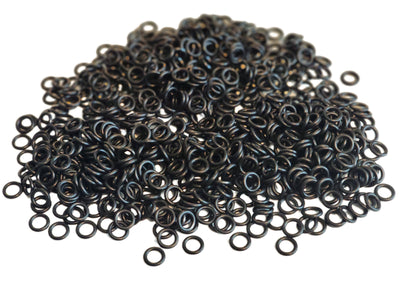
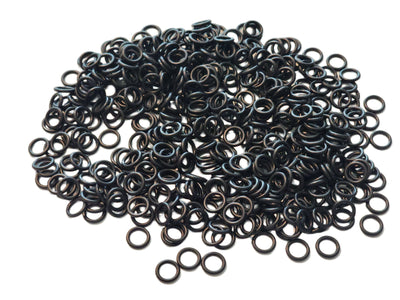
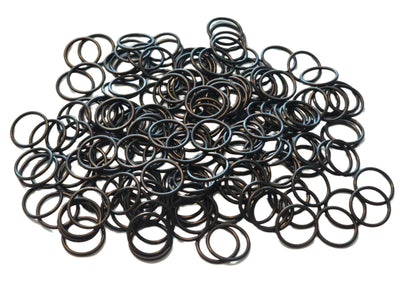
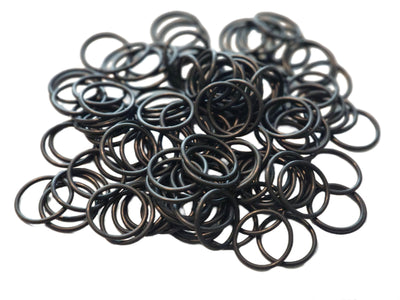
An O-ring seals by deformation. It sits in a groove, or between a shoulder and a face, and gets squeezed out of round when the parts close. That squeeze presses the rubber against both surfaces. Because it needs something to hold it in place, an O-ring belongs where the part was designed for one. Without a groove, it can roll or squeeze out of the joint.
O-rings come in standard AS568 "dash number" sizes, each with a fixed inside diameter and cross-section. Our O-rings are nitrile (Buna-N, NBR, 70A):
| Dash no. | ID | OD | Cross-section | Pack | O-ring |
|---|---|---|---|---|---|
| #010 | 1/4" | 3/8" | 1/16" | 100 | View |
| #011 | 5/16" | 7/16" | 1/16" | 100 | View |
| #017 | 11/16" | 13/16" | 1/16" | 100 | View |
| #121 | 1-1/16" | 1-1/4" | 3/32" | 100 | View |
| #230 | 2-1/2" | 2-3/4" | 1/8" | 10 | View |
| #357 | 5-1/2" | 5-7/8" | 3/16" | 1 | View |
The #357 is also sold as the 151122 / OR-100 replacement O-ring for Big Blue and Pentek filter housings. Not sure of your size? Try the O-ring size calculator.
Which one do you need?
- The seal goes under a screw, bolt or nut → a rubber washer. Match the ID to the fastener.
- The old part has a round cross-section and sat in a groove → an O-ring. Measure the ID and cross-section.
- The old part was flat and cut to the shape of a cover or flange → a gasket. Trace the outline, or ask the equipment maker for the part.
- A small round joint with a flat seat → a flat rubber washer of the right OD and ID often works as the gasket.
Material matters as much as shape
Our flat washers are neoprene, which handles general indoor and outdoor use. Our O-rings are Buna-N nitrile, which resists petroleum oils, fuels, hydraulic fluids and water, but is not recommended for direct sunlight or ozone exposure, brake fluid, ketones or concentrated acids. For a side-by-side comparison, see the rubber material guide and EPDM vs neoprene.
Popular rubber washer sizes
| Size (OD x ID x thickness) | Washer |
|---|---|
| 3/4" OD x 3/16" ID x 1/16" | View washer |
| 1" OD x 1/2" ID x 1/16" | View washer |
| 1-1/2" OD x 3/8" ID x 1/8" | View washer |
| 2" OD x 1" ID x 1/8" | View washer |
See all 18 sizes in rubber washers.
FAQ
Can I use a rubber washer instead of a gasket?
Often, yes, for a small round joint with flat faces. Choose a washer whose OD covers the sealing face and whose ID clears the opening. A 1/16" thick washer is the usual choice for sealing.
Can I use an O-ring instead of a washer?
Only where something holds the O-ring in place, such as a groove, a counterbore or a shoulder. Under a flat bolt head, an O-ring tends to squeeze out, so a flat washer is the better part there.
What is a rubber washer also called?
Sealing washer, flat rubber washer, rubber spacer, or, for the thick ones, a rubber bushing. They are all the same flat ring, sized OD x ID x thickness.
Is a hose washer a gasket or a washer?
It is a flat ring that seals a threaded joint, so it works as a small gasket even though it is called a washer. The name matters less than the shape and the size.
How fast do orders ship?
Orders ship from Elgin, SC, usually within 24 hours. Buying for a shop or a production run? Bulk tier pricing applies per item from 50 pieces (50+ 10% off, 500+ 20%, 1,000+ 30%, 2,500+ 40%, 5,000+ 50%).