Quick answer: rubber washers are sized OD x ID x thickness. The inside diameter (ID) should match your bolt or screw diameter. The outside diameter (OD) sets how much surface the washer covers. The thickness sets the job: 1/16" for sealing, 1/8" for cushioning, and 1/4" to 1/2" for spacing. A 1/4" bolt takes a 1/4" ID washer, and you choose the OD and thickness to suit the job.
Every washer in the chart below is a neoprene washer we stock. For a quick bolt-to-washer lookup, there is also the rubber washer size finder.
How to measure a rubber washer
- Inside diameter: measure across the hole. If the old washer is gone, measure the bolt's thread diameter instead. Calipers are best.
- Outside diameter: measure across the full washer at its widest point.
- Thickness: measure an uncompressed part of the old washer. A washer that has been clamped for years reads thinner than it started, so round up to the next standard thickness.
- Convert to fractions. The fraction, decimal and mm converter turns a caliper reading into the nearest size.
Measuring the bolt instead? The bolt and washer size chart lists common fastener diameters.
Bolt size to rubber washer ID
| Bolt or screw | Nominal diameter | Washer ID to choose |
|---|---|---|
| #10 | 0.190" | 3/16" (0.1875") – a snug, sealing fit |
| 1/4" | 0.250" | 1/4" |
| 5/16" | 0.3125" | 5/16" |
| 3/8" | 0.375" | 3/8" |
| 1/2" | 0.500" | 1/2" |
| 5/8" | 0.625" | 5/8" |
| 3/4" | 0.750" | 3/4" |
| 1" | 1.000" | 1" |
For sealing, a washer ID equal to the bolt, or very slightly under it, gives the tightest seal, because rubber stretches a little over the threads. For a spacer or cushion where sealing doesn't matter, an ID equal to or slightly over the bolt slides on more easily.
How thick should a rubber washer be?
- 1/16": sealing washers. Thin enough to clamp flat and fill small gaps under a screw head or around a fitting.
- 1/8": cushioning and general use. More give to take up uneven surfaces and stop rattles.
- 1/4": spacing and isolation. Holds a part off a surface and keeps two hard parts apart.
- 1/2": a thick rubber spacer that also works as a bushing.
How to choose the outside diameter
A common rule of thumb is an OD of about 2 to 3 times the ID. Go larger when you need more surface, for example to cover an oversized hole, spread over a soft material, or seal a wider face. Go smaller when space is tight next to an edge or another part.
Rubber washer size chart (all sizes we stock)
Sorted by inside diameter. All are neoprene and sold individually.
| ID | OD | Thickness | Washer |
|---|---|---|---|
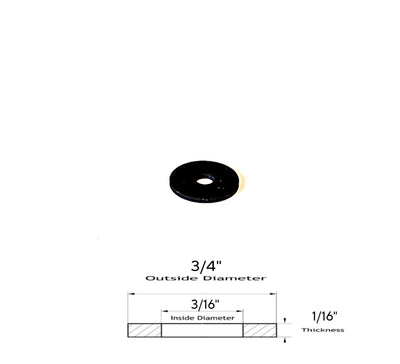
| 3/16" | 3/4" | 1/16" | View washer |
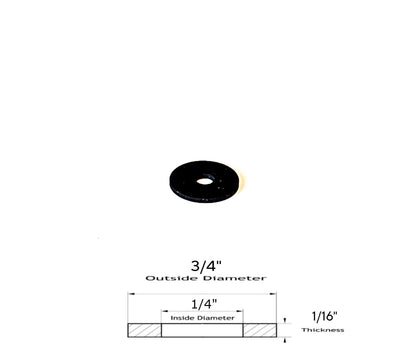
| 1/4" | 3/4" | 1/16" | View washer |
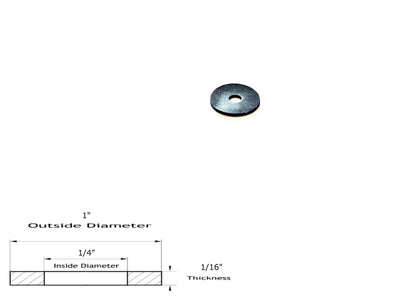
| 1/4" | 1" | 1/16" | View washer |
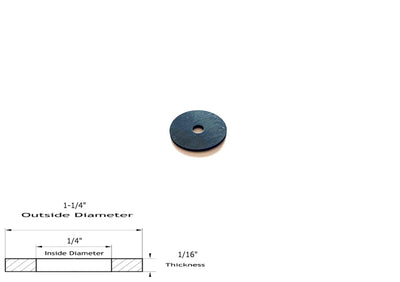
| 1/4" | 1-1/4" | 1/16" | View washer |
| 5/16" | 1-1/4" | 1/16" | View washer |
| 3/8" | 1" | 1/2" | View washer |
| 3/8" | 1-1/2" | 1/8" | View washer |
| 3/8" | 1-1/2" | 1/4" | View washer |
| 1/2" | 1" | 1/16" | View washer |
| 1/2" | 1-1/16" | 1/8" | View washer |
| 5/8" | 1-1/4" | 1/16" | View washer |
| 3/4" | 1-1/4" | 1/16" | View washer |
| 3/4" | 1-1/2" | 1/8" | View washer |
| 1" | 1-1/2" | 1/8" | View washer |
| 1" | 2" | 1/16" | View washer |
| 1" | 2" | 1/8" | View washer |
| 1" | 2" | 1/4" | View washer |
Browse them with photos and spec diagrams in rubber washers.
Rubber washer vs metal washer
A metal washer is rigid. It spreads the clamping force of a nut or bolt head and protects the surface underneath, but it doesn't seal or absorb anything. A rubber washer compresses, so it fills small gaps, keeps water and air out around the fastener, quiets rattles and keeps two hard parts from touching. Many installs use both: a metal washer on top to protect the rubber from the turning nut, and a rubber washer underneath to seal and cushion.
Tighten a rubber washer until it just starts to bulge at the edge. Past that point you squeeze it out of shape and the seal gets worse, not better.
Common jobs and the sizes to start with
- Sealing a small screw through sheet metal: the 3/4" x 3/16" x 1/16" washer for #10 screws, or the 3/4" x 1/4" x 1/16" for 1/4" screws.
- Stopping a rattle between two parts: a 1/8" thick washer whose ID matches the bolt.
- Spacing a part off a surface: the 1-1/2" x 3/8" x 1/4" or the 1" x 3/8" x 1/2" spacer for 3/8" bolts.
- Squeaky metal bed frame or shelf joint: a 1/16" or 1/8" washer between the two metal parts, with an ID that matches the bolt, stops metal-on-metal contact.
- Wide, thin seals around a 1" opening: the 2" x 1" x 1/16" washer.
Not sure whether you need a washer, a gasket or an O-ring? See gasket vs washer vs O-ring.
FAQ
What size rubber washer do I need for a 1/4" bolt?
A 1/4" ID. We stock it in 3/4", 1" and 1-1/4" OD, all 1/16" thick, which is the usual thickness for sealing.
Can a rubber washer's ID be smaller than the bolt?
Slightly. Rubber stretches, so a washer a few thousandths under the bolt size pushes on and seals tightly. Much smaller than that and it will tear or bunch up.
What are small rubber washers for screws called?
Usually sealing washers. Our smallest is 3/4" OD x 3/16" ID x 1/16", which suits #10 screws.
Neoprene or EPDM?
Our flat washers are neoprene, which suits general indoor and outdoor use. For a full comparison, see EPDM vs neoprene.
Do you sell rubber washers in bulk?
Yes. Washers are sold individually, so order the exact count. Buying for a shop or a production run? Bulk tier pricing applies per item from 50 pieces (50+ 10% off, 500+ 20%, 1,000+ 30%, 2,500+ 40%, 5,000+ 50%). Orders ship from Elgin, SC, usually within 24 hours.