Quick answer: choose a heavy-duty rubber bumper pad in four steps. Make the pad's face at least as big as the area that hits it. Choose a height that stops the moving part before metal touches metal. Pick the hardness: firmer rubber for repeated hard hits, softer rubber for quiet cushioning. Then choose the mounting: recessed metal washers or bolt holes for anything that takes a beating, never adhesive alone. The pads compared below are all solid molded rubber built to be screwed or bolted down.
A bumper pad is a sacrificial part. It takes the hit so your trailer gate, truck door, dock wall, lid or machine guard doesn't. A good one is sized so the hit lands squarely on rubber, mounted so it can't tear out, and hard enough not to flatten permanently.
Where heavy-duty bumper pads earn their keep
- Truck, trailer and van doors and tailgates that swing against the body
- Gates and doors that hit a wall, post or stop
- Loading docks, wall corners and guard rails where carts and equipment bump
- Lids, hatches and access panels on machinery, bins and toolboxes
- Equipment stops and end-of-travel stops on sliding parts
For full loading dock protection, larger molded dock bumpers are a separate category. See our loading dock and trailer bumpers.
1. Size the contact face
Look at where the two parts actually meet and measure that patch. The pad should cover the whole contact area with a little margin, so the moving part can't miss the rubber and strike the mounting screws or the surface around the pad. Long, narrow strike zones such as door edges and gate rails suit a long rectangular pad. Squarer impact points, such as a corner, a post or a dock face, suit a square or block pad.
2. Choose the height
Height is the gap the pad holds between the two parts. A taller pad gives more rubber to compress and stops the part earlier. A low-profile pad keeps a door or lid closing nearly flush. Measure the gap you want to keep when the part is fully closed or at full travel, and choose a pad that fills it. If the pad is too tall, the door won't latch. If it's too short, metal parts can still meet once the rubber compresses.
3. Pick the hardness
Rubber hardness is measured on the Shore A durometer scale. A higher number means firmer rubber.
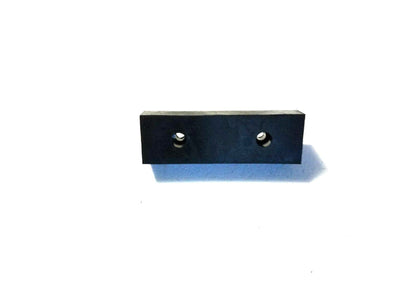
- Firmer pads (around 90 Shore A and up) hold their shape under repeated hard knocks and wear slowly. Our extra-hard rectangular bumper block is 95 Shore A.
- Medium pads (around 60 Shore A) give more cushioning and are quieter on contact. Several of our recessed-washer pads are solid SBR rubber at 60 Shore A.
Firmer rubber protects better against wear. Softer rubber absorbs more of the bang and noise. If the part slams hard and often, go firmer. If the aim is a quiet close, go softer.
4. Choose the mounting style
| Mounting | How it works | Best for |
|---|---|---|
| Recessed metal washers | Washers molded into the rubber sit below the face; screws clamp through them | Doors, gates, lids: the screw heads stay below the impact surface and the rubber won't tear out |
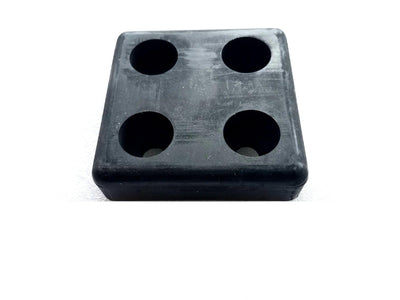
| Corner bolt holes | Bolt holes through a large pad hold it flat | Docks, walls and trailer frames with a wide impact face |
| Solid block | A solid block fixed at the contact point | Hard-hit stops where maximum rubber thickness matters |
Recessed washers are the reason these pads hold up: the metal spreads the clamping force, so you can tighten the screws fully without splitting the rubber. Smaller pads with the same design are sold as recessed rubber bumper feet with metal washers.
Heavy-duty bumper pads we stock
| Pad | Size (L x W x H) | Mounting | Notes |
|---|---|---|---|
| 4-hole square bumper pad | 4" x 4" x 1" | 4 corner bolt holes | Wide face for docks, walls, trailer frames |
| Rectangular bumper block | 3-1/2" x 1-1/2" x 1-1/4" | Block | Extra-hard, 95 Shore A |
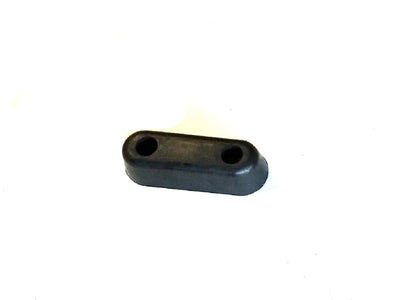
| Rectangular bumper pad | 2-1/2" x 1-1/4" x 7/8" | Solid pad | Truck and trailer doors, door stops |
| Long pad with metal washers | 4" x 1-1/4" x 3/4" | 2 recessed washers, 1/4" screws | Low-profile strike strip |
| Pad with metal washers | 2-3/4" x 1" x 1" | 2 recessed washers, 1/4" screws | SBR, 60 Shore A |
| 2" rectangular pad | 2" x 1" x 7/16" | Recessed washers, 1/4" screws | Compact cushion for lids and doors |
| Oval pad with metal washers | 1-3/4" x 5/8" x 1/2" | 2 recessed washers, 1/4" screws | SBR, 60 Shore A, small and low |
See them all in the heavy-duty rubber bumper pads collection.
Installation tips
- Test the position first. Hold the pad in place and close the door or lower the lid slowly to check that it lands squarely on the rubber.
- Use the right fasteners. Washer-type pads are designed for 1/4" screws. Outdoors, use stainless or coated hardware so rust doesn't stain the pad or seize the screws. Our screws, nuts and bolts cover common sizes.
- Snug, not crushed. Tighten until the washer is firmly seated. Over-tightening a pad without washers squeezes the rubber out of shape.
- Mount on a flat, solid surface. A pad on a flexing panel lets the panel take the hit instead.
- Inspect once in a while. Replace the pad when it is cracked, torn around a fastener or flattened so that metal parts come close to touching.
FAQ
Should I glue a heavy-duty bumper pad instead of screwing it?
Adhesive alone usually lets go under repeated impacts. Use the screw or bolt mounting. Adhesive can be added under the pad to stop it shifting, but it shouldn't be the only thing holding it.
Are bumper pads the same as anti-vibration pads?
No. Bumper pads stop impacts. To reduce vibration from running machines, use rubber vibration isolator mounts.
Hard or soft rubber for a trailer gate?
For a gate that slams often, a firmer pad lasts longer. For a light door where noise is the main problem, a 60 Shore A pad gives a softer, quieter stop.
Can I use these pads outdoors?
Yes. They are solid molded rubber used on trucks, trailers, docks and gates. Pair them with corrosion-resistant screws outdoors.