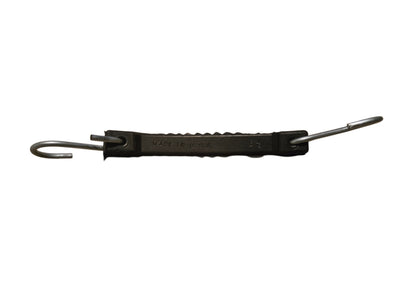
Quick answer: a rubber tarp strap is a solid rubber band with a metal S-hook at each end. It holds a tarp or cover tight by stretching between the tarp's grommet and an anchor point. Choose EPDM rubber for outdoor life, pick a strap whose installed stretch stays within its rated limit (our 5-1/2" straps are rated to stretch no more than 50%, to 8-1/4"), use enough straps that no single one carries the whole tarp, and never use them as the main tie-down for a heavy load.
Rubber tarp straps are popular because they do something ratchet straps and rope don't: they keep tension as a tarp flaps, sags or shrinks in the cold. That steady pull stops the flapping that tears grommets and lets rain pool on a cover.
Rubber tarp straps vs bungee cords
| Solid rubber tarp strap | Fabric-covered bungee cord | |
|---|---|---|
| Construction | One piece of solid rubber with S-hooks | Rubber strands inside a woven jacket |
| Outdoors | EPDM rubber resists UV, ozone and water | Jacket can fade, fray and hold water |
| Feel | Firm, steady pull | Softer, longer stretch |
| Typical use | Tarps, covers, wood piles, boat and trailer covers | Light bundling and general-purpose hooking |
Why the rubber compound matters
A strap that lives outside spends its life in sun, rain, frost and ozone. Ordinary rubber eventually cracks on the surface and snaps. Our rubber tarp tie-down straps are made from EPDM, a synthetic rubber chosen for its resistance to UV, ozone, weather and water. If you want to know why EPDM is the usual pick outdoors, our comparison of EPDM vs neoprene covers it in detail.
How to size a rubber tarp strap
The key number is stretch. A rubber strap pulls hardest and lasts longest when it is stretched a moderate amount. Overstretched, it is at risk of snapping. Understretched, it hangs loose and the tarp flaps.
- Measure the gap from the tarp grommet to the anchor point (a stake loop, rail, hook, or trailer tie point).
- Compare it with the strap's relaxed and maximum lengths. Our 5-1/2" strap has a maximum safe stretch of 8-1/4", which is 50% longer than its relaxed length. The rubber portion should sit somewhere between those two numbers when installed.
- Account for the hooks. Each strap has two 2-1/2" steel S-hooks. They hook into the grommet and the anchor, so the rubber itself only spans part of the gap.
- Too far? Don't overstretch a short strap to reach. Add a fixed anchor closer to the tarp, or bridge the gap with rope to a point that suits the strap.
How many tarp straps do you need?
Use enough straps that the tension is shared evenly. A tarp held by a few overstretched straps loads its grommets unevenly and tears. As a practical guide:
- Put a strap at every corner, then at every grommet or every other grommet along the edges.
- Add straps on the windward edge and anywhere the tarp can catch the wind.
- On a trailer or truck, strap the front edge most securely, because that is where moving air gets under the tarp.
- Keep a few spares. When one strap fails, the rest take on more tension.
Using rubber tarp straps safely
A stretched rubber strap stores energy. If a hook slips or the rubber snaps, the strap can recoil fast. These habits keep it safe:
- Wear safety glasses when stretching and hooking straps.
- Hook the far end first, then stretch toward you and hook the near end, keeping your face out of the strap's line of travel.
- Seat the hooks fully in the grommet and anchor, with the hook's open side facing away from you.
- Don't exceed 50% stretch on our straps.
- Inspect before each use. Discard any strap with cracks, cuts, or a hook that has opened up.
- They hold covers, not cargo. Rubber tarp straps are not a primary tie-down for securing heavy loads. Secure the load itself with tie-downs rated for it, then use rubber straps to hold the tarp.
Common uses
- Trailer, truck-bed and flatbed tarps
- Boat, RV, grill and equipment covers
- Firewood and lumber pile covers
- Tents, awnings and shade cloth
- Holding covers on ATVs, motorcycles and outdoor tools
Shop the rubber tarp tie-down straps collection for the 5-1/2" EPDM strap with S-hooks.
Care and storage
Rinse off mud and road salt, let straps dry, and store them out of direct sun when they are not in use. Keep them away from petroleum solvents, which can attack many rubbers. Even EPDM straps eventually show surface crazing after years outdoors. That is the sign to replace them before they snap.
FAQ
How far can a rubber tarp strap stretch?
It depends on the strap. Our 5-1/2" EPDM tarp straps are rated to stretch to 8-1/4" at most, which is 50% of their relaxed length.
Are rubber tarp straps better than bungee cords?
For tarps and covers that stay outside, solid EPDM straps usually last longer because there's no fabric jacket to fade, fray or hold water. Bungee cords stretch further, which suits loose bundling.
Can I use rubber tarp straps to secure a load?
No. Use them to hold a tarp or cover in place. Secure the load itself with tie-downs rated for the job.
Why do rubber straps crack?
Sun, ozone and heat age rubber over time. EPDM resists these much better than general-purpose rubber, but every strap should be inspected and replaced when cracks appear.