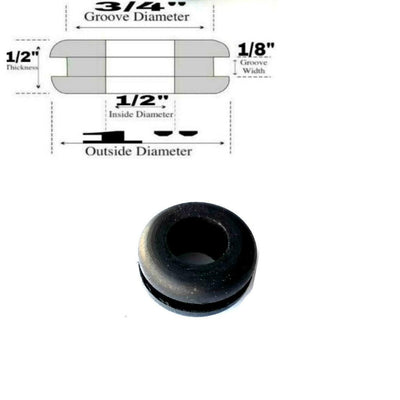
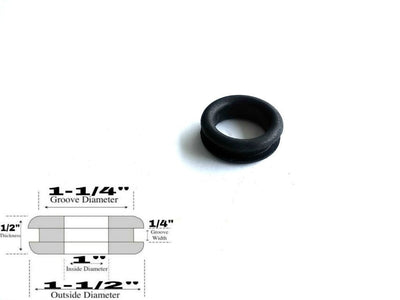
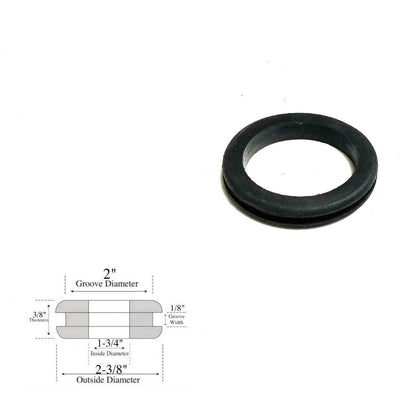
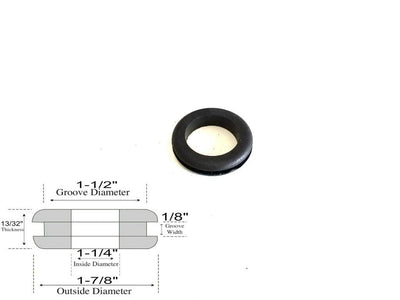
Quick answer: to choose a rubber grommet for wires, you need three measurements. The hole diameter sets the grommet's groove diameter. The panel thickness sets the groove width. The cable or bundle diameter sets the minimum inside diameter (ID). Pick a grommet whose groove matches the hole and panel, and whose ID lets the wires pass through without being squeezed. Our grommet size chart and finder lists every size by groove diameter.
Any time a wire passes through a hole in sheet metal, plastic or a wooden panel, the edge of that hole becomes a hazard. Vibration, pulling and temperature changes slowly saw through insulation. A rubber grommet lines the hole with a soft, rounded collar so that never happens. It also tidies the hole, blocks dust and stops loose cables rattling.
Where rubber wire grommets are used
- Electrical panels, breaker boxes and junction boxes: lining punched knockouts where low-voltage, thermostat or control wiring enters.
- Vehicles, trailers and boats: wiring through firewalls, bulkheads and body panels. See our guide to automotive firewall grommets.
- Machinery and control cabinets: sensor and power leads passing through enclosure walls.
- Desks, workbenches, server racks and AV cabinets: neat cable pass-throughs in drilled holes.
- DIY electronics and lighting: cord entries in project boxes, lamps and speaker cabinets.
The three measurements that pick the grommet
| Measure | Grommet dimension it sets | Rule of thumb |
|---|---|---|
| Hole diameter in the panel | Groove diameter | Match it exactly. A grommet with a 7/8" groove fits a 7/8" hole. |
| Panel thickness | Groove width | Equal to or slightly wider than the panel. Too narrow and it won't seat; much too wide and it rattles. |
| Cable or bundle diameter | Inside diameter (ID) | At least as large as the bundle, with room to thread the largest connector or plug if it has to pass through. |
Measure the hole with calipers across two directions. Punched and drilled holes are often slightly oval or burred. For the panel, measure the metal itself, not paint drips or a lip around the hole. Our step-by-step guide on how to measure a rubber grommet shows each dimension with diagrams, and what size rubber grommet do I need? gives the short version.
Our listings cover groove diameters from 1/4" to 4-3/16", groove widths from 1/16" (thin sheet metal) up to 1/2" (thick panels), and inside diameters from 1/8" up to 3-1/2". Each product title gives the ID, groove width and the hole it fits, so you can compare sizes at a glance in the rubber grommets collection.
Sizing a grommet for an electrical box knockout
Electrical enclosures use standard punched knockouts that are named for the conduit trade size they accept, not for the hole diameter. The hole is larger than the name suggests. Approximate diameters from common knockout punch charts (such as Greenlee's) are below. Always confirm with a caliper reading, because manufacturers vary slightly.
| Knockout (trade size) | Approx. hole diameter | Grommet groove to look for |
|---|---|---|
| 1/2" | 7/8" (0.875") | 7/8" groove grommets |
| 1" | about 1-3/8" (1.375") | 1-3/8" groove grommets |
| 1-1/4" | about 1-3/4" (1.734") | 1-3/4" groove grommets |
| 1-1/2" | about 2" (1.984") | 2" groove grommets |
| 2" | about 2-1/2" (2.469") | 2-1/2" groove grommets |
The most common knockout in residential boxes is the 1/2" trade size. Our rubber grommet for electrical panel box knockouts is made for exactly this job: it snaps into the knockout by hand and lines the sheet-metal edge.
A note on code: a grommet protects wire insulation, but it is not a cable clamp or strain relief. Where building wiring enters a box, local electrical codes generally call for a listed connector or clamp. Use grommets for low-voltage pass-throughs, unused openings and equipment where a grommet is the specified part, and follow your local code or a licensed electrician for mains wiring.
Open grommets vs blank (closed) grommets
- Open grommets have a through-hole for wires, hoses or cables. This is what most people mean by a wire grommet.
- Blank (closed) grommets have a solid centre. Use them to seal unused knockouts or holes against dust and drafts, or cut your own hole in the centre for a single small cable. See the blank hole grommets.
If the part will carry a moving shaft or sit under a clamping bolt, you may need a bushing rather than a grommet. Our article on grommet vs bushing explains the difference.
How to install a rubber wire grommet
- Deburr the hole. File or ream away sharp burrs so they can't cut into the groove.
- Fit the grommet before the wires. Pinch the grommet into a slight oval, hook one side of the groove over the panel edge, then work the rest in with your thumbs.
- Use a little help for tight fits. A drop of water or a rubber-safe lubricant on the groove lets it slip into place. Avoid oily lubricants, which can soften some rubbers.
- Check it is seated all the way round, with the panel edge fully inside the groove on both faces.
- Pass the wires through and leave a little slack on each side so the cable isn't pulling against the grommet.
FAQ
What size grommet fits a 7/8" knockout?
A grommet with a 7/8" groove diameter. Then choose a groove width that matches the box wall and an ID large enough for your cables.
How do I measure panel thickness for a grommet?
Use calipers on the bare panel edge next to the hole. Common sheet-metal panels are thin, so a 1/16" or 1/8" groove width is typical, while plastic enclosures and wood panels often need a wider groove.
Are rubber grommets waterproof?
A well-fitted grommet keeps out dust and splashes, but it is not a rated waterproof cable seal. For wet locations or enclosures with an ingress rating, use a cable gland or fitting rated for that environment.
Can I cut a rubber grommet to fit a bigger cable?
You can enlarge the centre of a blank grommet with a sharp hole punch. Trimming an open grommet weakens the collar, so it is better to choose a size with a larger ID.
Do you sell grommets for very thick panels?
Yes. Groove widths up to 1/2" are listed for thick panels, such as the 1" ID grommet with a 1/4" groove and larger. Filter the grommet size chart by groove width.