Quick answer: choose a rubber grommet in this order. 1) Measure the hole and pick grommets made for that exact hole size. 2) Measure the panel thickness and keep only grommets whose groove width is equal to or slightly wider than it. 3) From what's left, pick an inside diameter (ID) that clears the cable or hose, and an outside diameter (OD) that fits the flat area around the hole.
The rubber grommet size chart lists every size we stock against those numbers. This guide covers how to take each measurement and the mistakes that cause grommets to pop out.
Step 1: Measure the hole size
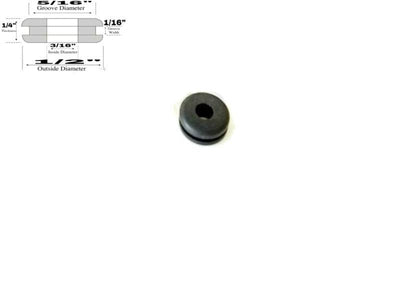
Use calipers if you have them. Measure across the hole in two directions, because punched and drilled holes are often slightly oval or burred. Take the smaller reading if they differ and remove any burr first. Convert the reading to the nearest fraction: 0.500" is 1/2", 0.625" is 5/8", 0.875" is 7/8", 1.0625" is 1-1/16". Our fraction, decimal and mm converter covers every size.
If you haven't drilled the hole yet, it's easier to work the other way around. Pick the grommet first, then drill the hole to its groove diameter with a matching step drill, hole saw or knockout punch.
Step 2: Match the groove width to the panel thickness
The groove is the channel the panel edge sits in. It has to be at least as wide as the panel, or the second flange can't snap over the back of the panel. A groove much wider than the panel lets the grommet wobble and rattle, so pick the narrowest groove that is still equal to or wider than your panel.
Sheet steel is often specified by gauge. Here is the standard thickness for common steel gauges and the narrowest groove width that fits each:
| Steel gauge | Nominal thickness | Narrowest groove that fits |
|---|---|---|
| 22 ga | 0.0299" (0.76 mm) | 1/16" (0.062") |
| 20 ga | 0.0359" (0.91 mm) | 1/16" (0.062") |
| 18 ga | 0.0478" (1.21 mm) | 1/16" (0.062") |
| 16 ga | 0.0598" (1.52 mm) | 1/16" (0.062") |
| 14 ga | 0.0747" (1.90 mm) | 5/64" (0.078") |
| 12 ga | 0.1046" (2.66 mm) | 1/8" (0.125") |
| 11 ga | 0.1196" (3.04 mm) | 1/8" (0.125") |
| 10 ga | 0.1345" (3.42 mm) | 3/16" (0.188") |
Gauge numbers mean different thicknesses for aluminum and stainless, so measure the actual panel when you can. Measure bare metal, not paint runs or a rolled lip around the hole. Plastic, wood and composite panels are usually thicker. For those, look at our 1/4", 3/8" and 1/2" groove widths.
One common trap is 14 gauge steel. At about 0.075" it is too thick for a 1/16" (0.0625") groove. Use a 5/64" or 3/32" groove, or step up to 1/8".
Step 3: Choose the inside diameter (ID)
The ID must clear what passes through it. For a single cable, choose an ID at least as large as the cable's outside diameter. For a bundle, wrap a strip of paper around it, mark the overlap, and divide the length by 3.14 to get the bundle diameter. If a plug or connector has to pass through the grommet during assembly, size the ID for the connector, not the cable. Rubber stretches a little, but forcing an oversize connector through can tear the grommet.
Step 4: Check the outside diameter (OD) and clearance
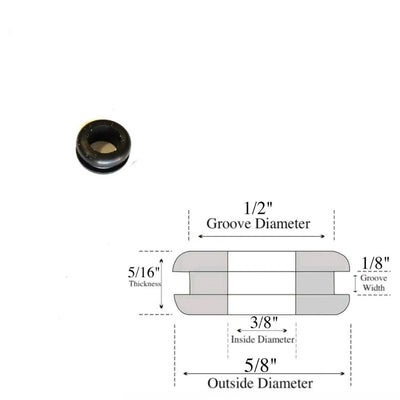
The flange on each side of the panel needs a flat area to sit on. As a rule, you need about (OD minus hole size) divided by two of flat material all around the hole. A 3/8" ID grommet with a 5/8" OD in a 1/2" hole needs only about 1/16" of flat metal around the edge. A large 2-3/4" ID grommet with a 3-5/8" OD in a 3" hole needs about 5/16". Keep holes far enough from bends, flanges and fasteners for the flange to lie flat.
Examples: matching common jobs to a grommet
| Job | Hole | Groove (max panel) | Grommet |
|---|---|---|---|
| Thin sheet metal (16 ga or thinner), 5/16" hole, small wires | 5/16" | 1/16" | 3/16" ID grommet |
| Sheet metal up to 1/8", 1/2" hole, wire or small tubing | 1/2" | 1/8" | 3/8" ID grommet |
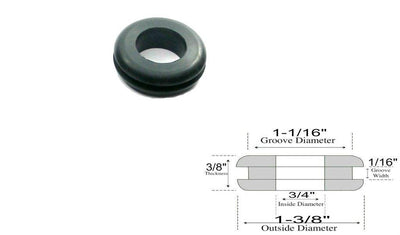
| 16 ga panel, 1-1/16" hole, wire bundle | 1-1/16" | 1/16" | 3/4" ID grommet |
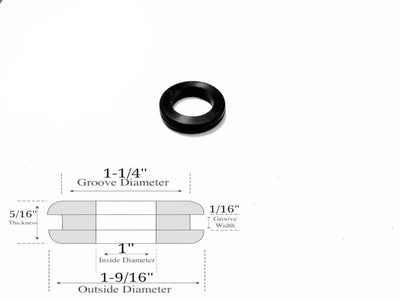
| 16 ga panel, 1-1/4" hole, cable or hose | 1-1/4" | 1/16" | 1" ID grommet |
| Panel up to 1/8", 1-5/8" hole, hose or harness | 1-5/8" | 1/8" | 1-5/16" ID grommet |
| 14 ga panel, 3" hole, large conduit or duct | 3" | 5/64" | 2-3/4" ID grommet |
| 16 ga panel, 2-7/8" hole, large hose or conduit | 2-7/8" | 1/16" | 2-3/8" ID grommet |
Buying in bulk? Case pricing.
Need hundreds or thousands of grommets for a production run, a fleet or a resale shelf? Our most-stocked sizes come in case packs at a lower price per piece than single pieces, and we quote larger quantities on request.
How to install a rubber grommet
- Deburr the hole so a sharp edge can't cut the groove.
- Push one side of the groove over the panel edge.
- Work around the hole with your thumbs, rolling the second flange over the back of the panel. For stiff or large grommets, a drop of soapy water on the groove helps it slide into place.
- Check that both flanges sit flat all the way around before passing the cable through.
Frequently asked questions
What happens if the groove is too narrow for my panel?
The grommet won't seat. One flange stays on top of the panel instead of locking behind it, and the grommet pushes out as soon as a cable moves. Choose the next wider groove.
What happens if the groove is too wide?
The grommet will fit but can slide back and forth and rattle, and it seals less well. A little extra width is fine, but pick the narrowest groove that is still equal to or wider than your panel.
Should I size a grommet by the cable or by the hole?
By the hole first, because a grommet only fits one hole size. Among the grommets for your hole size, pick the one whose ID clears the cable.
Can a rubber grommet go in a plastic or wood panel?
Yes, as long as the groove width matches the panel thickness. Those panels are thicker than sheet metal, so look at grooves of 1/4" and wider.
Where do I buy rubber grommets in bulk?
Quantity discounts apply automatically on every grommet. For production runs, our most-stocked sizes are also sold in case packs. See bulk case pricing.