Quick answer: for an electrical panel, control cabinet or junction box, choose a rubber grommet whose groove diameter equals the hole or knockout diameter and whose groove width is at least the enclosure's wall thickness. Standard 1/2" trade-size knockouts are 7/8" across, so they take a 7/8" groove grommet. Many steel enclosures are 16 gauge (about 0.060"), which a 1/16" groove fits. 14 gauge (about 0.075") needs a 5/64", 3/32" or 1/8" groove.
A grommet lines the sharp edge of a punched or drilled hole so it can't cut into wire insulation. That matters most where cables move or vibrate. Grommets also finish an open hole neatly and keep out some dust.
Where grommets are used in electrical enclosures
- Panel and breaker box knockouts: lining knockouts used for low-voltage, thermostat, data or control wiring.
- Control cabinets and machine panels: sensor leads, signal wires and pneumatic tubing passing through enclosure walls, internal partitions and back panels.
- Junction and pull boxes: protecting conductors where they pass through drilled holes.
- Server racks, network cabinets and AV enclosures: tidy cable entries in drilled holes.
- Equipment housings: cord entries on generators, compressors, pumps and lighting.
Important: a grommet is not a cable connector
In the US, the National Electrical Code generally requires cables entering a box or enclosure to be secured with a listed cable clamp or connector. A rubber grommet protects the insulation from the sharp edge, but it does not clamp the cable and does not take the place of a required connector. An open grommet also does not seal around a cable, so it won't make an enclosure watertight or keep its NEMA or IP rating. Use a rated cord grip or cable gland where you need that. Follow local code, and ask a licensed electrician when in doubt.
Knockout sizes and the grommet that fits
Knockouts are named by the conduit trade size they accept, not by the hole diameter. The hole is always larger than the name. The diameters below are typical values from standard knockout punch charts. Manufacturers vary slightly, so confirm with calipers.
| Knockout (trade size) | Typical hole diameter | Grommets that fit (in stock) |
|---|---|---|
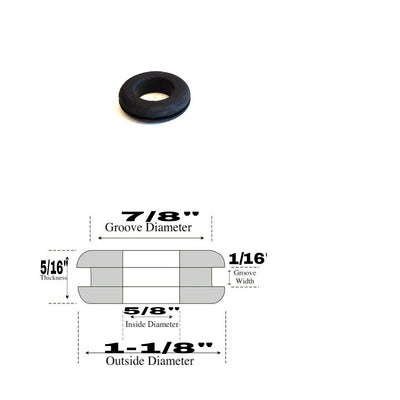
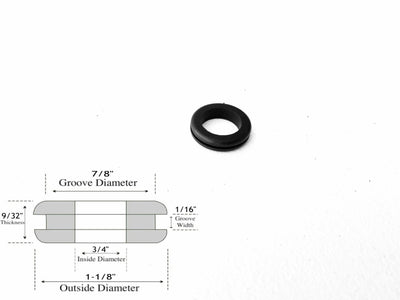
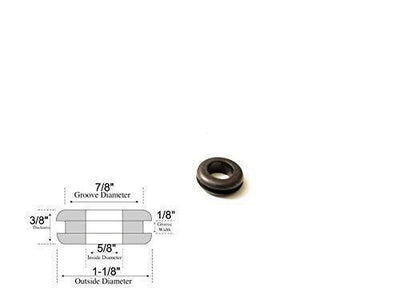
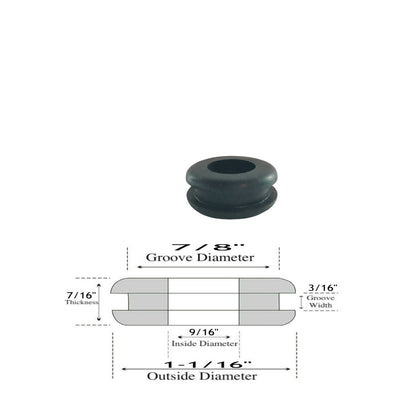
| 1/2" | 7/8" (0.875") | 5/8" ID, 1/16" groove; 3/4" ID, 1/16" groove; 5/8" ID, 1/8" groove; 9/16" ID, 3/16" groove; 5/8" ID, 3/16" groove; 3/4" ID, 3/16" groove |
| 3/4" | 1-3/32" (1.109") | No exact match in stock (a 1-1/16" groove is too small for this hole, and 1-1/8" is larger than the hole). Ask us |
| 1" | 1-3/8" (1.375") | 1" ID, 3/16" groove; 1-1/8" ID, 3/16" groove; 1" ID, 1/4" groove |
| 1-1/4" | 1-23/32" (1.734") | Use a 1-3/4" groove: 1-1/2" ID, 1/16" groove; 1-1/2" ID, 1/8" groove; 1-1/2" ID, 3/16" groove; 1-1/2" ID, 1/4" groove; 1-1/2" ID, 1/4" groove; 1-1/2" ID, 3/8" groove |
| 1-1/2" | 1-31/32" (1.984") | Use a 2" groove: 1-3/4" ID, 1/8" groove; 1-3/4" ID, 1/4" groove; 1-3/4" ID, 3/8" groove; 1-3/4" ID, 1/2" groove |
| 2" | 2-15/32" (2.469") | Use a 2-1/2" groove: 2-1/8" ID, 1/8" groove; 2" ID, 1/4" groove; 2-1/4" ID, 1/4" groove; 2-1/4" ID, 3/8" groove |
For the most common job, a 1/2" knockout in a residential panel or box, our rubber grommet for electrical panel box knockouts is the ready-made choice. More detail on wire grommets is in rubber grommets for wires and cables.
Enclosure wall thickness and groove width
| Enclosure wall | Approx. thickness | Groove width to use |
|---|---|---|
| 18 gauge steel | 0.048" | 1/16" |
| 16 gauge steel | 0.060" | 1/16" |
| 14 gauge steel | 0.075" | 5/64", 3/32" or 1/8" |
| 12 gauge steel | 0.105" | 1/8" |
| 10 gauge steel | 0.135" | 3/16" |
| Polycarbonate / fiberglass enclosures | measure, often 1/8" or more | 1/8" to 1/4" |
Gauge numbers are approximate guides. Check the enclosure's data sheet or measure the wall at the hole.
Grommets for drilled holes in control cabinets
Inside control cabinets and machine panels, holes are usually drilled or step-drilled to suit the cable rather than punched to a trade size. These sizes cover most of those jobs, and we stock all of them in depth:
| Grommet | Hole | Groove (max wall) | Typical use |
|---|---|---|---|
| 3/16" ID grommet | 5/16" | 1/16" | Single sensor, thermocouple or signal wires |
| 3/8" ID grommet | 1/2" | 1/8" | Small control wires, pneumatic tubing |
| 3/4" ID grommet | 1-1/16" | 1/16" | Wire bundles between cabinet sections |
| 1" ID grommet | 1-1/4" | 1/16" | Multi-core control cables |
| 1-5/16" ID grommet | 1-5/8" | 1/8" | Larger harnesses and hoses |
| 2-3/8" ID grommet | 2-7/8" | 1/16" | Large conduit or hose pass-throughs |
| 2-3/4" ID grommet | 3" | 5/64" | Large pass-throughs in 14 ga enclosure walls |
Buying in bulk? Case pricing.
Need hundreds or thousands of grommets for panel builds for a production run, a fleet or a resale shelf? Our most-stocked sizes come in case packs at a lower price per piece than single pieces, and we quote larger quantities on request.
Installing grommets in enclosures
- De-energize and lock out the equipment before working inside any panel.
- Punch or drill the hole, then deburr both sides so the edge can't nick the groove.
- Seat one side of the groove on the edge and roll the rest in with your thumbs.
- Pull the cable through after the grommet is seated, then secure the cable with the clamp or connector your installation needs.
Frequently asked questions
What size grommet fits a 1/2" knockout?
A 1/2" trade-size knockout is about 7/8" in diameter, so use a grommet with a 7/8" groove diameter. Check the wall thickness against the groove width. Our electrical panel knockout grommet and the 7/8" groove sizes in the table above all fit.
What size grommet fits a 3/4" knockout?
A 3/4" trade-size knockout is about 1-3/32" (1.109"). Grommets made for 1-1/16" holes are too small for it. Ask us for a matching size, or use a 1-3/8" hole and grommet if you are punching new holes.
Can I use a rubber grommet instead of a cable connector?
Not where code requires a connector or clamp. The grommet protects the insulation from the sharp edge, while the connector secures the cable. Many installations use both.
Are rubber grommets waterproof?
An open grommet seals the gap around its own edge, not around the cable passing through it. For wet locations or rated enclosures, use a cord grip or cable gland made for that rating.
Do you sell electrical grommets in bulk for panel shops?
Yes. Our deep-stock sizes come in case packs, and we quote 10,000+ pieces. See bulk case pricing.