Quick answer: an O-ring is defined by two numbers, its inside diameter (ID) and its cross-section (CS), the thickness of the ring itself. The outside diameter follows from those two (OD = ID + 2 × CS). Measure the groove or the part the ring seals, not just the old ring, then match the size to a standard AS568 dash number and choose a rubber compound that suits the fluid and temperature. Get those three things right and an O-ring is one of the most reliable seals there is.
Rubber O-rings turn up in faucets, filter housings, pumps, pressure washers, hydraulic fittings, pool equipment and air tools. Most leaks after a replacement come from the same few mistakes: a ring that is the wrong cross-section, a compound that swells in the fluid, or a ring that was twisted or nicked on the way in. This guide walks through each step.
How an O-ring seals
An O-ring sits in a groove (a "gland") and is squeezed slightly out of round when the parts are assembled. That squeeze presses the rubber against both surfaces and closes the leak path. Under pressure, the fluid pushes the ring against the far wall of the groove, which tightens the seal further. Two things follow from this:
- The cross-section matters most. A ring that is too thin won't be squeezed enough to seal. A ring that is too thick overfills the groove, gets pinched and can tear.
- The rubber has to stay elastic. A compound that hardens with heat, or swells in oil, loses its squeeze and starts to weep.
If you are not sure whether your job needs an O-ring at all, our guide to gasket vs washer vs O-ring explains when a flat washer or gasket is the better part.
Step 1: Measure the O-ring correctly
| Dimension | What it is | How to measure |
|---|---|---|
| ID (inside diameter) | Across the hole of the ring | Calipers across the inside, or measure the shaft or groove bottom it sits on |
| CS (cross-section) | The thickness of the rubber cord | Calipers across the cord, pressing lightly so you don't squash it |
| OD (outside diameter) | Across the outside of the ring | Calculated: ID + 2 × CS, or measure the bore it fits into |
Tips for an accurate measurement:
- Don't trust a worn ring completely. Old O-rings flatten (rubber engineers call this compression set) and often stretch. A ring that measured 1/8" when new may now read 0.120" across one direction and 0.150" across the other. Measure the groove or the mating part as a cross-check.
- Measure the cross-section in two places and use the rounder reading.
- Convert carefully. Inch O-rings use fractions that don't map neatly to millimetres. Our fraction / decimal / mm converter and O-ring size calculator do the arithmetic for you.
Step 2: Match it to an AS568 dash number
Most inch-size O-rings in North America follow SAE AS568, a standard list of sizes that each carry a "dash number" such as -011 or -230. The first digit of the dash number tells you the cross-section family, which is the quickest way to narrow your search:
| Dash series | Nominal cross-section | Actual cross-section |
|---|---|---|
| -0xx (e.g. -010, -011, -017) | 1/16" | 0.070" (1.78 mm) |
| -1xx (e.g. -121) | 3/32" | 0.103" (2.62 mm) |
| -2xx (e.g. -230) | 1/8" | 0.139" (3.53 mm) |
| -3xx (e.g. -357) | 3/16" | 0.210" (5.33 mm) |
| -4xx | 1/4" | 0.275" (6.99 mm) |
Notice that the "nominal" fraction is a name, not the exact size. A #011 is sold as 5/16" ID, but its actual ID is 0.301". That is why measuring with calipers and checking a chart beats guessing from the fraction. Our full O-ring size chart lists the standard dash sizes with inch and metric dimensions.
Step 3: Choose the rubber compound
The right size in the wrong rubber still fails. Match the compound to what the ring will touch and how hot it gets:
- Nitrile (Buna-N / NBR): the general-purpose choice for petroleum oils, fuels, hydraulic fluid and water. The nitrile O-rings we stock are 70A durometer with a listed temperature range of -40°F to 250°F.
- EPDM: a common choice for hot water, steam and outdoor weathering, but it is not suited to petroleum oils or fuels.
- Silicone: stays flexible across very wide temperature ranges and is common in food and appliance equipment, but it tears more easily and is a poor choice for moving seals.
- Fluorocarbon (FKM): used where fuels, solvents or high heat would attack other rubbers.
Before you order, check the fluid against our rubber compatibility chart and the temperature resistance chart. The rubber material guide explains the trade-offs in more detail.
Rubber O-ring sizes we stock
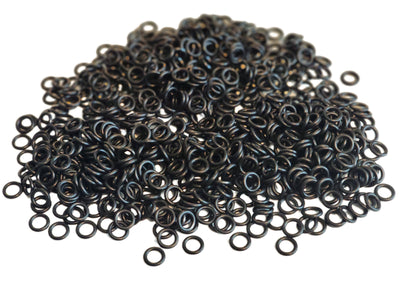
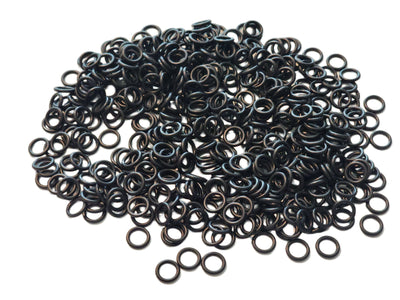
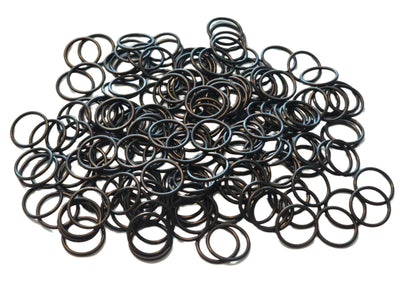
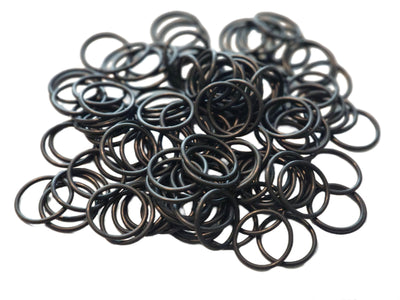
All of these are black nitrile (Buna-N) O-rings, 70A durometer, in standard AS568 sizes. Browse them together in our rubber O-rings collection.
| AS568 | ID | OD | Cross-section | Pack |
|---|---|---|---|---|
| #010 | 1/4" | 3/8" | 1/16" | 100 |
| #011 | 5/16" | 7/16" | 1/16" | 100 |
| #017 | 11/16" | 13/16" | 1/16" | 100 |
| #121 | 1-1/16" | 1-1/4" | 3/32" | 100 |
| #230 | 2-1/2" | 2-3/4" | 1/8" | 10 |
| #357 | 5-1/2" | 5-7/8" | 3/16" | 1 |
Replacing the large ring in a water filter housing? Our filter housing O-ring guide and the step-by-step leaking filter housing fix cover how to measure and swap it.
Step 4: Install it without damaging it
- Clean the groove. Old rubber flakes, grit or dried lubricant under a new ring create a leak path.
- Lubricate lightly with a lubricant that is compatible with the compound. Silicone grease is widely used on nitrile O-rings in water equipment; avoid petroleum grease on EPDM.
- Don't drag it over sharp edges. Threads and port edges can nick the ring. Cover threads with tape or a thin sleeve if you have to pass over them.
- Don't roll or twist it into place. A spiral twist in the groove is a common cause of a slow leak. Check that the mould line runs straight around the ring once it's seated.
- Tighten evenly and only as far as the parts are designed to go. Over-squeezing an O-ring doesn't make it seal better.
When to replace an O-ring
Replace an O-ring when it is flattened square, cracked, sticky, swollen or noticeably harder than a new one, or any time you take apart a joint that has been sealed for a long time. Rings are inexpensive compared with the cost of a leak, and a used ring rarely seats the same way twice. Keeping a pack of the common sizes on hand makes routine maintenance quick.
FAQ
What does the O-ring dash number mean?
It is the size code from the SAE AS568 standard. Each dash number corresponds to one ID and cross-section combination, and the first digit tells you the cross-section family: -0xx is 1/16", -1xx is 3/32", -2xx is 1/8", -3xx is 3/16" and -4xx is 1/4".
How do I measure an O-ring without calipers?
You can wrap a thin strip of paper around the outside of the part the ring sits on to find the circumference and divide by 3.14 for the diameter, but cross-section is hard to judge by eye. A basic set of calipers is the most reliable way, and our O-ring size calculator helps you turn the readings into a standard size.
Can I use an O-ring that is slightly bigger or smaller?
Stick to the size the groove was designed for. A ring that is too large can bunch up and leak, and one with a thinner cross-section won't be squeezed enough to seal. If you can't find the exact size, measure the groove and compare it with the O-ring size chart.
Are rubber O-rings reusable?
Sometimes, if the ring is still round, soft and undamaged. In practice, it is best to fit a new ring whenever you open a sealed joint.
What is the difference between an O-ring and a rubber washer?
An O-ring has a round cross-section and seals by being squeezed in a groove. A rubber washer is flat and seals by being clamped under a fastener or between two faces.