Quick answer: measure the hole, or the inside of the pipe, at its narrowest point. Then choose the plug style. A push-in hole plug suits holes in sheet metal and thin panels. A tapered line-sealing plug suits pipe ends, tubes, drains and holes drilled in thicker material. A blank (closed) grommet suits larger panel holes from 5/8" to 1-1/2". Every size in this guide is one we stock, so the tables double as a shopping list.
Rubber plugs look simple, but most returns come from the same three mistakes: measuring the wrong diameter, ordering by a pipe's nominal size, or ignoring how thick the panel is. The steps below avoid all three.
Step 1: Pick the right type of rubber plug
| Plug type | Best for | How it holds | Sizes we stock |
|---|---|---|---|
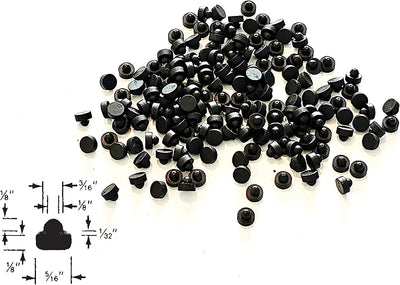
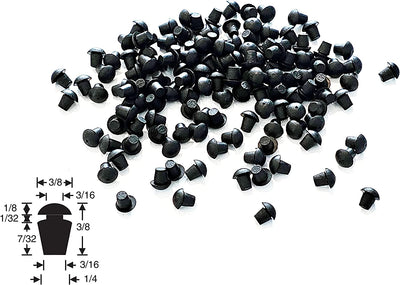
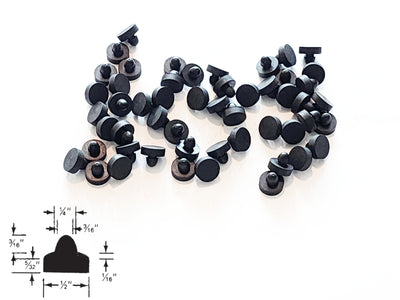
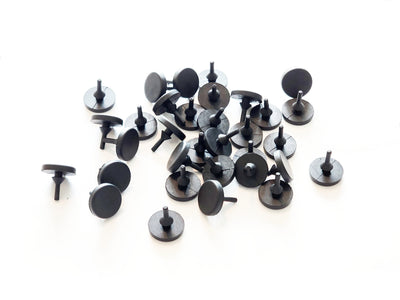
| Push-in hole plug | Holes in sheet metal, appliance bases, enclosures and thin panels | A groove under the head snaps over the panel edge | Holes from 1/8" to 1/2", panels 1/32" to 3/16" |
| Line-sealing stopper plug | Pipe and tube ends, drains, drilled holes in tanks and thick parts | A tapered solid-rubber stem compresses into the opening and holds by friction | Stems 11/32", 3/8", 31/64", 1/2" and 19/32" |
| Blank / closed grommet | Larger round holes in panels and firewalls with nothing passing through | A groove grips the panel; the closed centre seals the hole | Holes 5/8", 13/16", 15/16" and 1-1/2" |
If something needs to pass through the hole, such as a wire, cable or hose, you want an open grommet, not a plug. Use the rubber grommet size chart instead.
Step 2: Measure the hole correctly
- Measure the hole diameter, not the old plug's head. The head is always larger than the hole. Calipers are best. If you don't have them, find the drill bit whose shank just slides into the hole and read its size.
- For a sheet-metal hole, also measure the panel thickness. A push-in plug's groove has to match the panel. If the groove is too wide, the plug rattles. If it's too narrow, the plug won't seat.
- For a pipe, measure the inside diameter. Pipe sizes are nominal. A pipe sold as "1/2 inch" does not have a 1/2" opening, and the inside diameter changes with the pipe type and wall thickness. Measure the opening you are actually plugging.
- Check the depth. A line-sealing plug's stem should go fully into the opening, so make sure there is at least as much depth as the stem length in the table below.
Working in millimetres? The fraction, decimal and mm converter turns a caliper reading into the nearest fraction.
Rubber plugs for holes in sheet metal and panels
Push-in plugs are sorted by the hole they fit and the panel thickness their groove is made for. Head size is diameter x height. The same parts work as push-in bumper feet on appliance bases and equipment trays.
| Fits hole | Panel thickness | Head (dia x height) | Plug |
|---|---|---|---|
| 1/8" | 1/32" | 5/16" x 1/8" flat | View plug |
| 3/16" | 1/32" | 3/8" x 1/8" oval | View plug |
| 3/16" | 1/16" | 1/2" x 5/32" flat | View plug |
| 7/32" | 1/8" | 7/8" x 11/64" flat | View plug |
| 1/4" | 3/64" | 1/2" x 11/64" oval | View plug |
| 1/4" | 3/64" | 9/16" x 3/8" | View plug |
| 1/4" | 1/16" | 3/8" x 1/8" flat | View plug |
| 1/4" | 1/16" | 1/2" x 5/32" flat | View plug |
| 1/4" | 1/16" | 1/2" x 1/4" flat | View plug |
| 1/4" | 1/8" | 9/16" x 1/8" flat | View plug |
| 9/32" | 5/64" | 9/16" x 1/8" flat | View plug |
| 9/32" | 1/8" | 5/8" x 11/32" flat | View plug |
| 5/16" | 1/16" | 3/8" x 5/32" | View plug |
| 5/16" | 3/32" | 5/8" x 1/4" flat | View plug |
| 3/8" | 1/8" | 3/4" x 3/4" flat | View plug |
| 1/2" | 1/8" | 1" x 3/16" | View plug |
| 1/2" | 3/16" | 1" x 5/16" flat | View plug |
Several plugs fit a 1/4" hole. Choose by panel thickness first, then by how large and tall you want the head to be.
Rubber plugs for pipes, tubes and drains
Line-sealing stopper plugs have a tapered solid-rubber stem with a flat head that stops at the opening. Press one in by hand. The stem compresses against the wall of the hole or pipe and holds by friction, with no threads, adhesive or tools. Choose the stem diameter that matches your opening.
| Stem diameter | Stem length | Head diameter | Overall length | Plug |
|---|---|---|---|---|
| 11/32" | 9/16" | 1/2" | 23/32" | View plug |
| 3/8" | 11/16" | 5/8" | 7/8" | View plug |
| 31/64" | 11/16" | 37/64" | 31/32" | View plug |
| 1/2" | 1" | – | – | View plug |
| 19/32" | 7/8" | 3/4" | 1" | View plug |
Common jobs for these plugs include capping open tube ends, sealing drilled holes in tanks and sinks, closing a line during pressure tests or winterizing, masking holes during painting or powder coating, and closing unused mounting holes. The 1/2" rubber plug is our most popular size for 1/2" holes and drains.
A friction-fit plug is not a pressure-rated pipe cap. For a line that will run under pressure, use a cap or fitting rated for that pressure.
Rubber plugs for larger panel holes (5/8" to 1-1/2")
For bigger round holes in a panel or firewall, a blank grommet is the cleanest plug. It has no centre hole, but the inside rubber is thin, so you can trim it out later if you ever need to pass a wire through. All four sizes have a 1/16" groove width, so they suit thin sheet metal.
| Fits hole | Groove width | Outside diameter | Thickness | Plug |
|---|---|---|---|---|
| 5/8" | 1/16" | 7/8" | 5/16" | View grommet |
| 13/16" | 1/16" | 1-1/8" | 5/16" | View grommet |
| 15/16" | 1/16" | 1-1/8" | 1/4" | View grommet |
| 1-1/2" | 1/16" | 1-13/16" | 5/16" | View grommet |
Tips for a tight fit
- Between two sizes? For a line-sealing plug, a stem equal to the hole or slightly larger compresses and grips. A stem smaller than the hole won't hold. More detail is in the rubber plug size guide.
- Clean the hole first. Burrs, paint flakes and old sealant stop a plug from seating. Deburr sharp sheet-metal edges so they don't cut the groove.
- Press, don't hammer. Push the plug in with your thumb, using a slight rocking motion. A drop of soapy water helps a tight stem slide in.
- Outdoor, fuel or oil exposure? Check the compound in the rubber material guide before you order.
When a plug isn't the right part
If you are capping the outside of a tube or leg rather than plugging the opening, you want a rubber cap tip that pushes over the end. If the hole is for a wire, hose or cable, use a grommet sized with what size rubber grommet do I need.
FAQ
What size rubber plug do I need for a 1/2" hole?
For a 1/2" pipe end, drain or drilled hole, use the 1/2" line-sealing plug (1" long stem). For a 1/2" hole in a panel, use a push-in plug: the 1" x 3/16" plug for 1/8" panels, or the 1" x 5/16" plug for 3/16" panels.
What size plug fits a 1/4" hole?
We stock six push-in plugs for 1/4" holes. Pick by panel thickness (3/64", 1/16" or 1/8"), then by head size. They are all in the sheet-metal table above.
Can I use a rubber plug in a PVC pipe?
Yes, to close the opening. Measure the pipe's actual inside diameter, not its nominal size, and match it to a stem diameter. For a line that will be pressurized, use a rated cap or fitting instead.
Are rubber plugs reusable?
Yes. Both push-in and line-sealing plugs hold by grip and friction, not adhesive, so you can pull them out and refit them.
Do you sell rubber plugs in bulk?
Yes. Every plug is sold individually, so order the exact count you need. Buying for a shop or a production run? Bulk tier pricing applies per item from 50 pieces (50+ 10% off, 500+ 20%, 1,000+ 30%, 2,500+ 40%, 5,000+ 50%). Orders ship from Elgin, SC, usually within 24 hours.